Floor

Factory Guide

Steaming the Soybeans

Steaming the Soybeans
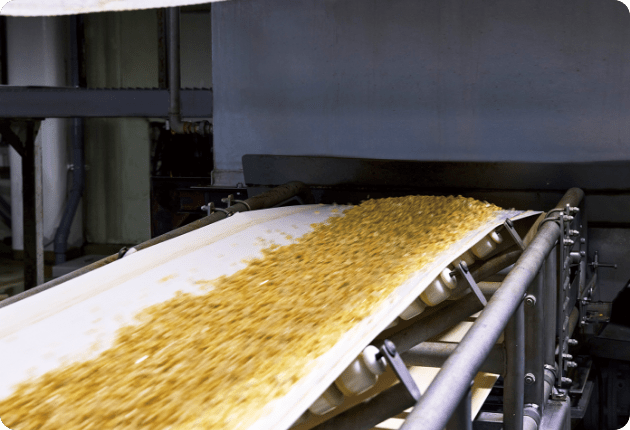
Soybeans are firmer than they look, making it difficult to cook them all the way through.
First, washed soybeans are soaked in water until they are thoroughly saturated.
Once the soybeans have absorbed water and doubled in size, they are steamed to create delicious, plump soybeans.
Soybeans

We use umami-rich soybeans in our additive-free miso production process.
Soaked Soybeans

Soybeans that have absorbed sufficient water swell to twice their original size.
Steamed Soybeans

Steamed soybeans become slightly smaller and darker than soaked soybeans.
Continuous Steamer for Perfect Soybeans
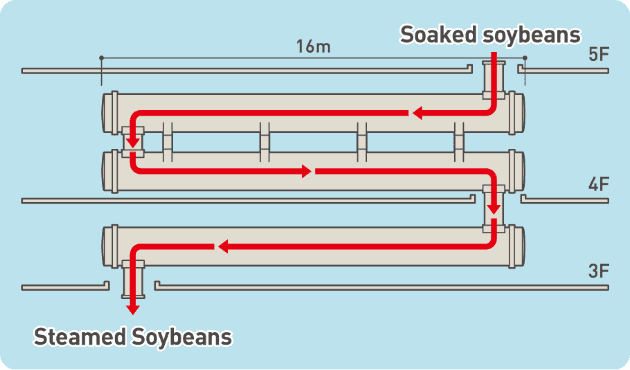
A “continuous steamer” is a long, massive pressure cooker that steams soybeans. It takes 15 minutes for the soybeans to travel through the 48-meter-long steamer, emerging as delicious steamed soybeans that retain their natural umami and aroma.
[ Advantages of the Continuous Steamer ]
In a continuous steamer, the soybeans are spread out in a uniform layer along a conveyor belt, ensuring they are steamed evenly.

Steaming helps the soybeans retain their natural nutrients and umami.

Each soybean is heated for the same amount of time, ensuring a uniform finish.

Because convection does not occur as it would in a typical pot, the soybeans are less likely to be crushed or have their hulls split.